Last updated: October 8, 2026
Prediction markets are becoming a major part of the US betting and trading industry. Platforms such as Kalshi and Polymarket allow people to take positions on the outcomes of sporting events, elections, economic announcements, and other real-world events.
But are prediction markets legal in Ohio?
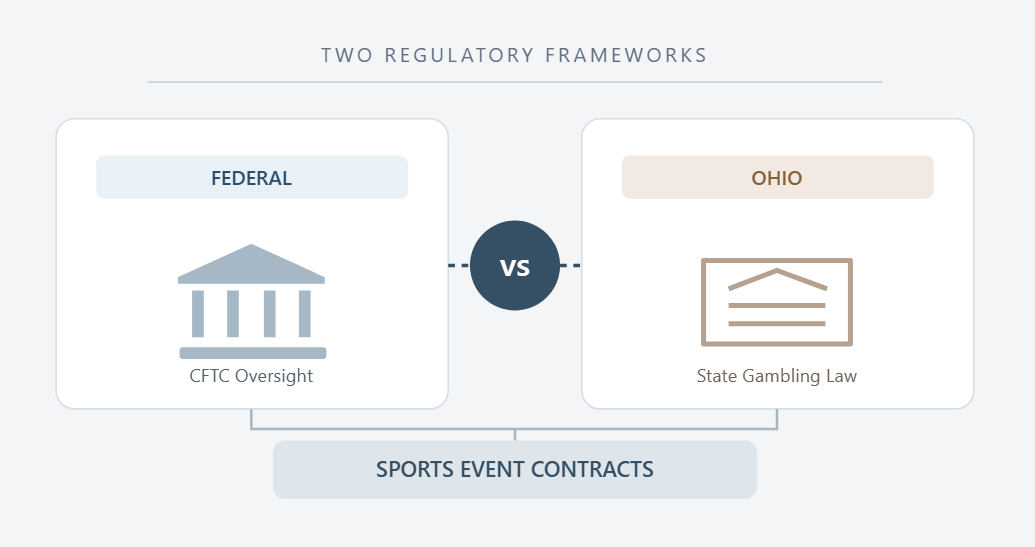
The answer depends on what you’re trading. Ohio regulators consider certain sports prediction contracts to be illegal sports wagering when offered without a state license. Prediction market operators argue that these contracts are financial products regulated at the federal level.
That disagreement has already reached the federal appeals courts. On September 25, 2026, a major ruling went against Kalshi and strengthened Ohio’s ability to enforce its gambling laws.
Here is what Ohio residents need to know about prediction market laws, the leading platforms, and how event contracts differ from traditional sports betting.
Are Prediction Markets Legal in Ohio?
Prediction markets are not categorically illegal in Ohio, but sports prediction contracts offered without an Ohio sports gaming license face significant legal restrictions.
Ohio has a regulated sports betting market overseen by the Ohio Casino Control Commission (OCCC). Companies offering conventional sports wagers must comply with state licensing and consumer protection requirements.
Prediction markets operate differently. Platforms such as Kalshi offer event contracts on exchanges registered with the Commodity Futures Trading Commission (CFTC), the federal agency that regulates US derivatives markets.
However, federal registration doesn’t automatically mean a company can offer every type of sports contract in Ohio.
The OCCC considers certain sports-event contracts to be sports gambling, even when they are traded on a federally regulated exchange.
This has created a dispute over which laws apply.
For residents, the most important distinction is between contracts involving financial or economic events and those based on sporting outcomes. The legal position can differ depending on the particular contract and platform.
Ohio’s Latest Court Ruling: September 2026
On September 25, 2026, the US Court of Appeals for the Sixth Circuit issued an important decision in litigation involving Kalshi and gambling regulators in Ohio and Tennessee.
Kalshi argued that its sports-event contracts fell under the federal Commodity Exchange Act and that federal law prevented state regulators from enforcing their gambling laws against those contracts.
The Sixth Circuit rejected that argument in the preliminary injunction proceedings.
The court concluded that Kalshi had not shown its sports-event contracts met the relevant federal statutory definition of a swap. It also found that even if the contracts qualified as swaps, federal law would not prevent Ohio and Tennessee from enforcing their gambling laws.
The court therefore upheld an earlier Ohio decision denying Kalshi a preliminary injunction. It also overturned a preliminary injunction that had protected Kalshi from enforcement in Tennessee.
What does this mean for Ohio residents?
The ruling strengthens Ohio’s position that sports prediction contracts can fall under state gambling laws, despite being offered through a federally registered exchange.
Importantly, this was an appeals court decision concerning preliminary injunctions. It did not finally resolve every issue in the underlying litigation or prohibit all prediction market contracts.
However, it means Kalshi did not obtain the protection from Ohio enforcement that it sought at this stage.
Why Is Ohio Challenging Sports Prediction Markets?
Ohio legalized online sports betting in January 2023 and established a regulatory framework for licensed operators.
Sportsbooks must comply with requirements covering licensing, minimum age, identity verification, responsible gambling, advertising, and consumer protection.
Prediction market exchanges operate under a different federal framework.
The disagreement is straightforward: if someone buys a contract on whether the Cincinnati Bengals will win their next game, is that a financial trade or a sports bet?
Ohio regulators argue that the economic substance of the transaction matters more than the terminology used to describe it.
On March 31, 2025, the OCCC issued cease-and-desist notices to Kalshi, Robinhood, and Crypto.com concerning sports-event contracts.
The regulator argued that those products constituted sports wagering and required the appropriate Ohio authorization.
The dispute has since expanded nationally.
On April 30, 2026, Ohio Attorney General Dave Yost helped lead a bipartisan coalition of 41 state attorneys general urging the CFTC to recognize state authority over sports-related prediction markets.
The companies involved dispute this interpretation and maintain that federally regulated contracts fall under the appropriate derivatives framework.
This conflict between federal and state regulation is now one of the central legal issues facing the prediction market industry.
Sources: Ohio Attorney General — April 30, 2026 and the Sixth Circuit opinion cited above.
Prediction Market Apps in Ohio
Several major companies now offer prediction market products in the United States.
However, the platforms don’t all provide the same contracts. Just because an app is available to download doesn’t mean Ohio residents can legally trade every market displayed on it.
The table below covers some of the best-known platforms and their relevance to Ohio.
| Platform | Main Markets | Position in Ohio |
|---|---|---|
| Kalshi | Sports, politics, economics, culture | Sports-event contracts face Ohio enforcement and litigation |
| Polymarket US | Event contracts across several subjects | Federally registered exchange; specific Ohio sports-market eligibility not independently confirmed |
| Robinhood | Financial and sports event contracts | Ohio has challenged sports contracts; availability depends on product |
| DraftKings Predictions | Sports and other real-world events | Separate from DraftKings Sportsbook; Ohio contract restrictions must be checked |
| FanDuel Predicts | Finance, economics, selected sports | Financial contracts included in its national model; sports contracts excluded in states with legal online sports betting |
The table is an overview of the platforms, not a confirmation that every listed product can currently be traded in Ohio. Specific market availability may change following legal or regulatory decisions.
Kalshi
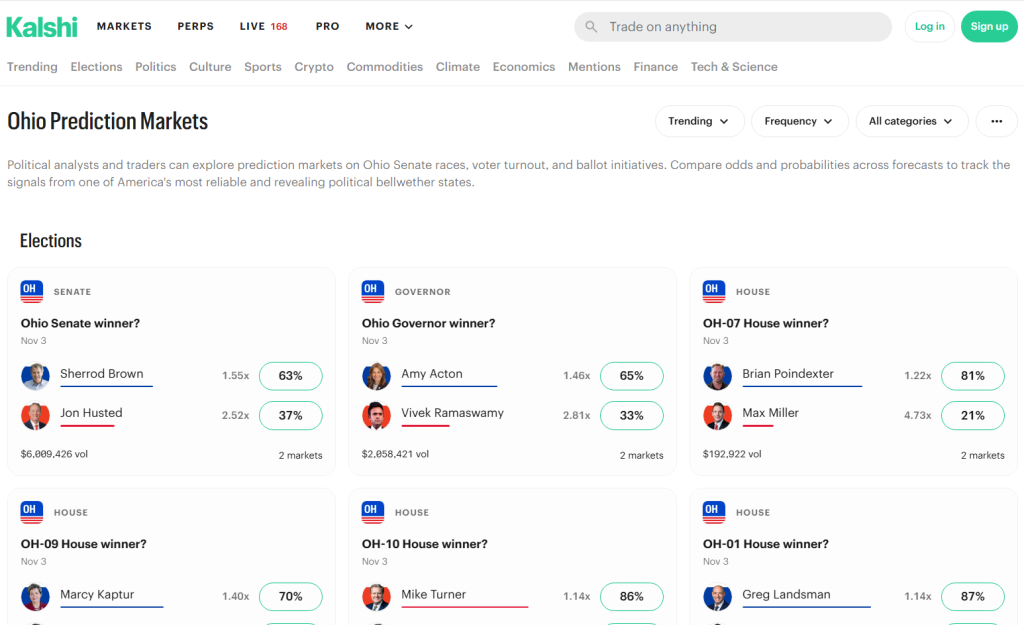
Kalshi is one of the best-known prediction market exchanges in the United States.
The platform offers event contracts covering economics, politics, sports, weather, and popular culture.
Unlike a traditional sportsbook, Kalshi allows participants to buy and sell positions in event contracts, with prices changing as trading activity and expectations change.
Kalshi has been registered with the CFTC as a designated contract market since November 2020.
However, its sports-event contracts have been at the center of Ohio’s regulatory dispute since 2025.
The September 2026 Sixth Circuit ruling means Kalshi has not established that federal commodities law prevents Ohio from enforcing its sports gambling laws against the contracts at issue.
This doesn’t mean every Kalshi market is prohibited. Economic and financial event contracts present different regulatory questions from contracts based on the results of sporting events.
Ohio residents should therefore distinguish between Kalshi’s different products rather than assuming that federal registration settles the legality of sports predictions.
Polymarket
Polymarket became widely known during the 2024 US presidential election, when its political prediction markets attracted international attention.
Its markets have also covered economic developments, entertainment, technology, and sports.
An important distinction for US customers is that Polymarket US is not the same service as Polymarket’s international platform.
Polymarket returned to the regulated US market through the acquisition of an existing exchange business.
The CFTC lists QCX LLC, operating as Polymarket US, as a designated contract market.
This establishes its federal exchange registration, but it doesn’t mean every contract offered through the wider Polymarket ecosystem is available to Ohio residents.
In particular, the status of individual sports-event contracts should be checked separately in light of Ohio’s regulatory position.
Robinhood Prediction Markets
Robinhood has expanded beyond stocks, ETFs, and cryptocurrency to offer event contracts through regulated exchange arrangements.
This is an interesting development because prediction markets are reaching customers who may already use financial trading apps but have never used a sportsbook.
Robinhood’s prediction products include markets based on economic developments and sporting outcomes.
However, Robinhood was also among the companies that received an Ohio cease-and-desist notice concerning sports-event contracts in March 2025.
That makes its regulatory position particularly relevant to Ohio residents.
The availability of specific contracts can depend on the exchange, product, and location. Its reputation as an investing platform should not be taken as proof that all sports-related contracts are authorized under Ohio law.
DraftKings Predictions
DraftKings is already one of Ohio’s largest licensed sportsbook operators, but it has also entered the prediction market industry.
DraftKings Predictions operates separately from DraftKings Sportsbook, offering event contracts rather than conventional sportsbook wagers.
The product allows eligible customers to trade on outcomes covering different real-world events, with market availability varying by jurisdiction.
This distinction matters in Ohio because holding a state sportsbook license doesn’t automatically establish that a separate prediction market product has the same authorization or regulatory treatment.
DraftKings publishes eligibility information for its Predictions platform, and customers should check which markets are available in Ohio rather than assuming that access to the sportsbook and prediction platform is identical.
FanDuel Predicts
FanDuel launched its prediction market platform in partnership with CME Group in December 2025.
FanDuel Predicts is a separate app offering event contracts connected to financial benchmarks, economic indicators, and selected sporting outcomes.
Financial markets can include subjects such as stock market indexes, inflation, commodity prices, and economic announcements.
FanDuel’s announced approach to sports contracts differs from that of some competitors.
The company said sports-event contracts would be offered in states where legal online sports betting was unavailable.
Since Ohio already has regulated online sports betting, sports contracts are excluded under that announced model.
This makes FanDuel Predicts an example of how an established sportsbook can enter prediction trading without offering sports contracts in every state where its traditional sportsbook operates.
Source: FanDuel and CME Group’s December 22, 2025 launch announcement.
What Are Prediction Markets and How Do They Work?
Prediction markets allow participants to trade contracts based on whether a particular event will happen.
Most commonly, contracts have two outcomes: Yes or No.
For example, a market could ask:
Will the Federal Reserve lower interest rates at its next meeting?
Suppose a Yes contract costs $0.60.
If you buy 100 contracts, the total cost would be $60, excluding any fees.
If the Federal Reserve makes the specified decision and the market settles at $1 per correct contract, those 100 contracts pay $100.
Your profit would be $40 before fees.
If the event doesn’t happen, the Yes contracts generally expire worthless, and you lose the $60 paid.
Unlike a conventional fixed-odds sports bet, some prediction market positions can be sold before the event concludes.
For instance, if new information increases demand for Yes contracts, the market price may rise. A trader might then sell at a higher price without waiting for settlement.
However, selling early depends on market liquidity, and the price can also move in the opposite direction.
Contract prices are often used as an indication of market expectations.
A contract priced at $0.60 can be interpreted as suggesting roughly a 60% market-implied probability, although fees, spreads, and trading conditions can affect that interpretation.
The price is not a guarantee or an independently verified probability.
Prediction Markets vs. Sports Betting in Ohio
At first glance, prediction markets and traditional sportsbooks can look similar, particularly when they offer products based on sporting results.
A sportsbook might allow someone to bet on the Cleveland Cavaliers winning their next game.
A prediction market could offer a contract based on the same outcome.
However, the way the products are priced, traded, and regulated differs.
| Feature | Ohio Sportsbooks | Prediction Markets |
|---|---|---|
| Product | Sports wagers | Event contracts |
| Pricing | Fixed or changing sportsbook odds | Prices formed through market trading |
| Main regulator | Ohio Casino Control Commission | CFTC, with disputed state authority over sports contracts |
| Minimum age | 21 | Depends on platform and product |
| Early exit | Cash-out where available | Selling a contract where trading is available |
| Markets | Authorized sporting events | Sports, economics, politics, culture, and other events |
| Fees | Generally included in the odds | Trading fees and bid-ask spreads may apply |
One important difference is the ability to trade positions before an event takes place or concludes.
However, prediction markets aren’t automatically better value.
Sportsbooks generally build their margin into their odds, while prediction market traders may pay explicit transaction fees and face bid-ask spreads.
A contract that initially appears cheaper than a sportsbook wager might provide a lower net return once those costs are included.
For anyone comparing the two, the important figure is the potential return after all applicable costs, not simply the price displayed on the screen.
Can Ohio Residents Trade on NFL, NBA, or College Football Outcomes?
Ohio residents aged 21 and older can legally place eligible sports wagers through operators licensed by the OCCC.
This includes betting markets on NFL, NBA, MLB, NHL, and permitted college sporting events.
Prediction market contracts based on those same sports present a different legal issue.
Ohio regulators have maintained that offering certain sports-event contracts without a state license violates Ohio gambling laws.
The September 2026 Sixth Circuit ruling strengthened that position by rejecting Kalshi’s argument that federal law protected the sports contracts at issue from state enforcement at the preliminary injunction stage.
This does not mean every contract connected to sports has been definitively ruled illegal, nor does it establish the legal status of every prediction market platform.
It does mean that Ohio residents should not assume a sports contract is authorized simply because a federally registered exchange offers it.
For conventional sports betting, the established regulated option remains an Ohio-licensed sportsbook.
Are Prediction Markets Safe?
CFTC-registered exchanges operate under federal regulatory requirements, but prediction market trading still involves financial and legal risks.
A participant can lose the entire amount paid for a contract.
There are also other factors worth considering:
- Market liquidity: Some contracts attract limited trading activity, making positions harder to sell.
- Fees and spreads: Transaction fees and the difference between buying and selling prices can reduce returns.
- Settlement rules: The specific wording of a contract determines how an outcome is resolved.
- Regulatory uncertainty: Legal challenges can affect which contracts platforms may offer.
- Market volatility: Prices may change significantly as new information becomes available.
It is also worth distinguishing between the financial risk of a contract and the regulatory status of the platform providing it.
CFTC registration offers a federal regulatory framework, but it doesn’t guarantee profits or settle whether particular sports contracts comply with Ohio law.
Before using a platform, review its registration, eligibility requirements, fee schedule, contract rules, and risk disclosures.
The Future of Prediction Markets in Ohio
Prediction markets have expanded considerably since the first widely used political and financial event exchanges.
Major companies including Kalshi, Polymarket, Robinhood, FanDuel, and DraftKings are now participating in the industry.
Sports predictions have become an important part of that expansion, but they have also created tension with states that already operate regulated gambling markets.
Ohio is one of the states at the center of this dispute.
The September 2026 Sixth Circuit ruling is a significant development, although further litigation, regulatory action, and changes in platform restrictions remain possible.
For Ohio residents, the most important distinction is between federally regulated event contracts generally and sports contracts that Ohio considers subject to its gambling laws.
Ohio.Bet will continue covering these developments as the legal position becomes clearer.
Frequently Asked Questions
Are prediction markets legal in Ohio?
Prediction markets are not subject to a blanket prohibition in Ohio. However, the state considers certain sports-event contracts offered without a sports gaming license to violate its gambling laws. The legal position depends on the contract and regulatory framework.
Is Kalshi legal in Ohio?
Kalshi is a CFTC-registered exchange, but its sports contracts face enforcement challenges from Ohio regulators. In September 2026, a federal appeals court upheld the denial of Kalshi’s request for preliminary protection against Ohio enforcement. That ruling did not prohibit all Kalshi contracts.
Can I use Polymarket in Ohio?
Polymarket US operates through a federally registered exchange. However, Ohio access and eligibility for particular contracts, especially sports contracts, must be confirmed through the US service. Federal registration does not resolve every question under Ohio gambling law.
Is Robinhood Prediction Markets legal in Ohio?
Robinhood offers event-contract trading through regulated arrangements, but Ohio issued a cease-and-desist notice concerning sports-event contracts in 2025. Customers should distinguish financial event contracts from sports contracts and verify current product restrictions.
Is FanDuel Predicts available in Ohio?
FanDuel Predicts announced nationwide financial event-contract coverage, including Ohio, through a phased rollout. Under its announced model, sports contracts are not offered in states with legal online sports betting, including Ohio. Actual account and market availability should be confirmed in the app.
Are prediction markets considered gambling?
This is legally disputed, particularly for sports contracts. Prediction market operators generally structure their products as financial derivatives, while Ohio considers certain sports-outcome contracts to fall under state gambling laws.
Do I need to be 21 to use prediction markets in Ohio?
Ohio requires sports bettors to be at least 21 years old. Some federally regulated prediction market platforms have an 18+ account minimum, depending on the product. Those age requirements do not override applicable Ohio gambling restrictions.
Are prediction markets better than sportsbooks?
Not necessarily. Prediction markets can offer competitive prices, but transaction fees, spreads, and liquidity affect their value. Comparing the net return on the same outcome is more useful than assuming either option is always cheaper.